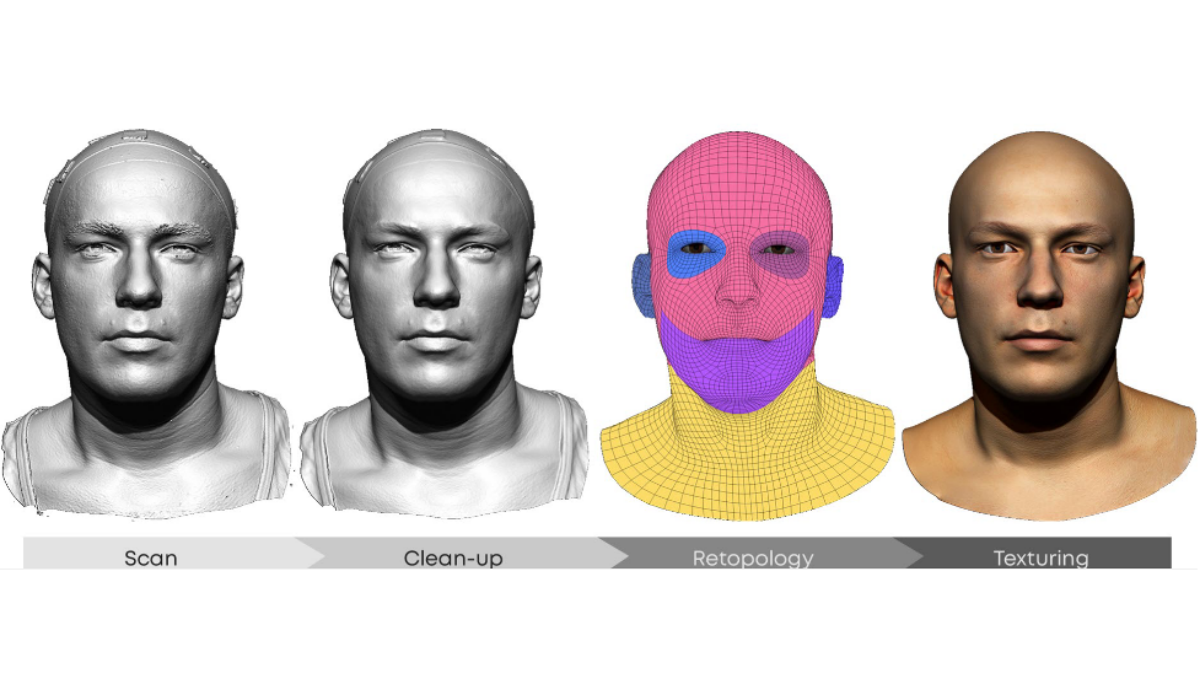
In digital 3D character creation, achieving realism in texturing and shading is paramount. The ability to create lifelike surfaces and materials dramatically enhances the believability and immersion of the characters. This article will explore some techniques professionals use to achieve realistic texturing and shading, breathing life into their digital creations.
High-Quality Texture Maps
Creating high-quality texture maps is crucial for realistic character rendering. Artists often use multiple maps, such as colour, specular, normal, and displacement, to create different surface attributes. Each map provides specific information about the building components of the Physical Based Rendering. By carefully crafting and painting these maps, artists can add details like pores, wrinkles, and imperfections, contributing to the character’s realism.
Photorealistic Material Scans
To achieve unparalleled realism, some artists employ the technique of photorealistic material scans. Using specialised scanning equipment involves capturing real-world materials like fabrics, metals, or skin. The resulting scanned data can be used as texture maps or as references for artists to recreate the materials digitally. By leveraging the intricate details and nuances of real materials, digital characters can achieve unprecedented realism.
Subsurface Scattering
One of the critical elements in realistic character rendering is capturing the effect of light passing through the character’s skin. Subsurface scattering (SSS) simulates how light scatters beneath the surface, resulting in a soft, translucent appearance. Artists can use SSS shaders to accurately mimic the behaviour of light interacting with different types of skin or organic materials. This technique adds depth and realism to the character’s skin, making it look more natural and lifelike.
PBR Workflow
Physically Based Rendering (PBR) is a widely adopted workflow that focuses on accurately capturing the physical properties of materials. PBR workflows utilise a combination of texture maps, material properties, and lighting setups to achieve realistic results. The PBR approach ensures that materials respond realistically to different lighting conditions and environments, producing more cohesive and believable characters.
Procedural Texturing
Procedural texturing is a powerful technique that allows artists to create complex and realistic textures using mathematical algorithms instead of traditional painting techniques. This method enables the generation of intricate patterns, weathering effects, and natural variations, adding depth and complexity to the character’s surfaces. Procedural texturing helps create natural elements like foliage, rocks, and terrains.
Final sentences
Realistic texturing and shading are essential aspects of creating believable 3D characters. Artists can breathe life into their digital creations by employing techniques such as high-quality texture maps, photorealistic material scans, subsurface scattering, PBR workflows, and procedural texturing. These techniques, combined with artistic vision and attention to detail, allow for the creation of characters that captivate audiences and seamlessly blend into their virtual worlds. As technology advances, we can expect even more sophisticated tools and techniques to push the boundaries of realism in 3D person scanning and rendering, enhancing our digital experiences.