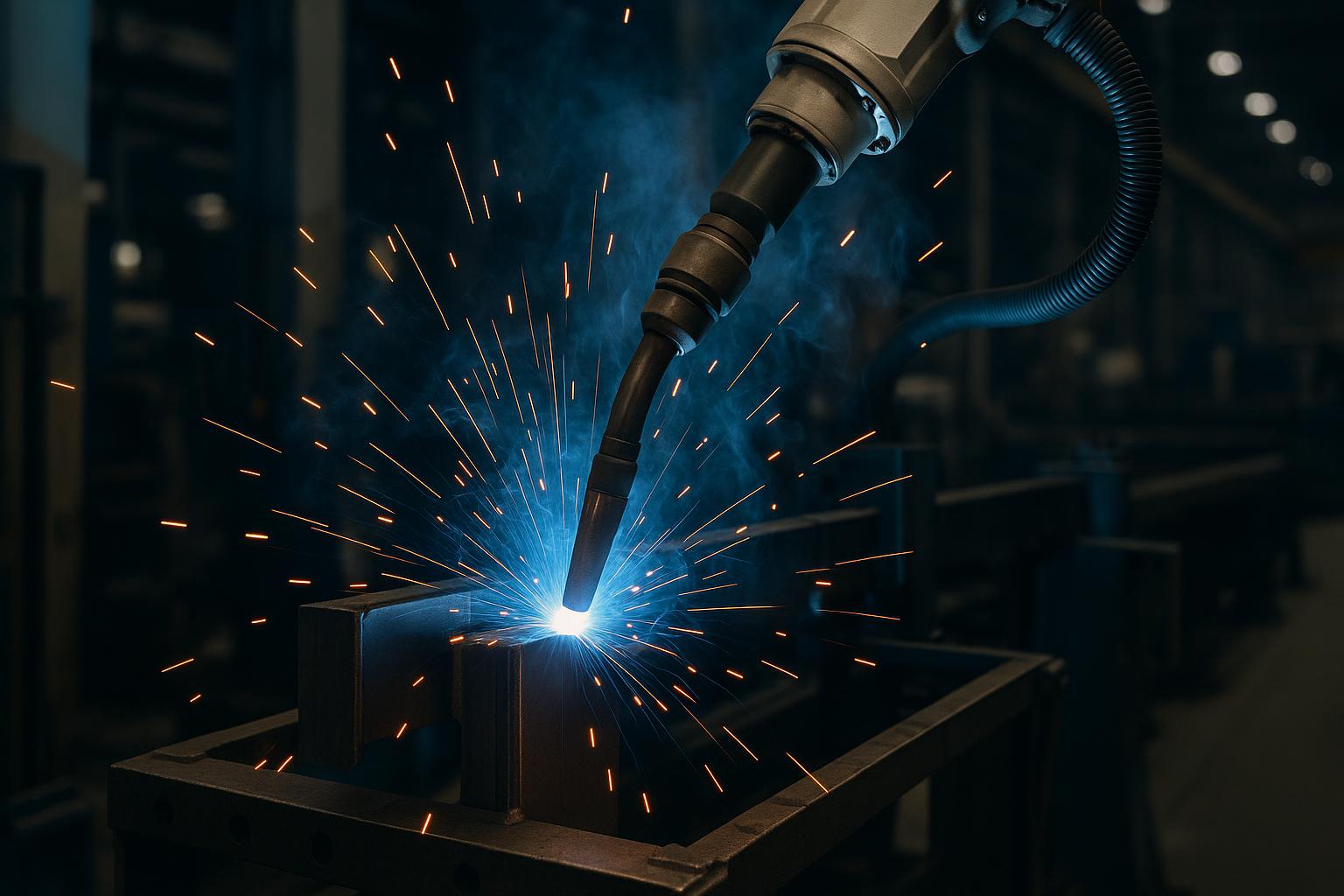
Not all structurally sound welding operations are appropriate for industrial production. Manufacturing needs go beyond joining two pieces of metal. Knowing the difference between a production-ready process and a capable but limited one helps you make informed decisions about process selection and investment.
Consistency and repeatability across production runs
The hallmark of an industrial welding process is its ability to produce the same weld repeatedly. And with a degree of robustness that is independent of:
- Operator skill
- Material variability
- Environmental influences.
Repeatability means that it can be achieved over thousands of joints.
A process that relies heavily on individual operator technique results in production inconsistencies between operators, shifts, and production runs. This creates quality control issues and rework costs that quickly build up at scale.
In industrial production, the shape and quality of the welds are dependent on weld parameters such as:
- Heat input
- Travel speed
- Wire travel speed (wire feed rate)
- Beam position.
These elements must be precisely controlled, monitored, and reproduced. The stricter the tolerance requirements of the component being produced, the more critical this repeatability will become.
Control and management of heat input
Welding processes vary widely in the amount of heat they deliver to the base metal and in the degree of heat control that can be achieved. Some processes introduce excessive or poorly controlled heat. This can cause distortion, metallurgical changes in the heat-affected area, and dimensional accuracy issues. This is especially true in an industrial production setting where thin materials, dissimilar metals, or heat-sensitive parts are prevalent.
Industrial Laser Welding solves this problem by providing a degree of heat input control which is unattainable with conventional arc processes. The highly concentrated energy of the focused laser beam creates a narrow fusion zone with a minimal heat-affected zone. This yields strong, clean joints in materials and geometries that would be compromised by the wider heat-affected zone of MIG, TIG, or plasma welding.
For manufacturers producing components with thin walls or low-thermal-conductivity materials, this thermal precision is a production requirement. It determines whether the process is viable.
Speed and throughput compatibility
The welding process might be excellent. But if it cannot keep up with the surrounding production line, it remains a bottleneck that slows overall output.
In an industrial production environment, cycle time is optimized. A welding process is assessed not only by weld quality but also by how fast it produces welds and how it interacts with upstream and downstream processes.
Some processes can be quick. But the time saved in the weld is consumed by the pre-weld or post-weld preparation or finishing. A truly production-proven process reduces the overall cycle time for the entire sequence of operations. Not just the welding speed.
Automation and integration capability
Currently, many industrial manufacturing processes are based on automated and semi-automated production systems. A welding process that is not suitable for automation or semi-automation reduces the scalability and efficiency of the production line.
The level of automation for a welding process is determined by:
- The complexity of the process parameters
- The stability of the feedstock
- The capability of the process to adapt to the real-time signals from sensors and control systems.
Processes that have fewer variables to control and are more predictable in their behavior when operating under defined parameter sets are easier to automate than processes that need continuous human adjustments. The advent of fully automated welding cells in high-volume manufacturing is attributed to two reasons: enhancing productivity and minimizing operator-dependent variability in weld quality.
Material compatibility for various applications
Most industrial manufacturers do not use one material in one thickness for each product.
A welding process might perform well on mild steel in a standard thickness range. But it cannot handle aluminum, stainless steel, dissimilar metal combinations, or thin-gauge materials. This limits the flexibility of the production line and may require multiple process investments to cover the full material range the business works with.
When evaluating a welding process, consider the full range of material combinations that will be used in the production process. A reputable industrial welding company like Micro Weld, Inc can help you with that.
Quality assurance & inspection compatibility
In industrial production environments, welded joints need to be reliably inspected and certified against quality standards.
Some processes create non-uniform internal features such as:
- Inconsistent penetrations
- Porosity
- Inclusions
- Inconsistent fusion.
This creates inspection challenges that slow production and increase the percentage of joints that must be remediated or rejected.
Clean and predictable welds lessen inspection workload. They meet the quality assurance needs of industrial customers and regulatory bodies for manufactured parts.
Summing up
A welding process is qualified for industrial production if it is capable of providing consistent quality, controlled heat input, manufacturing-compatible speed, automation, material flexibility, and an acceptable total cost of operation.
No process is optimal for all applications. But assessing the options based on the above characteristics will provide a framework to choose a process that will enhance production performance.