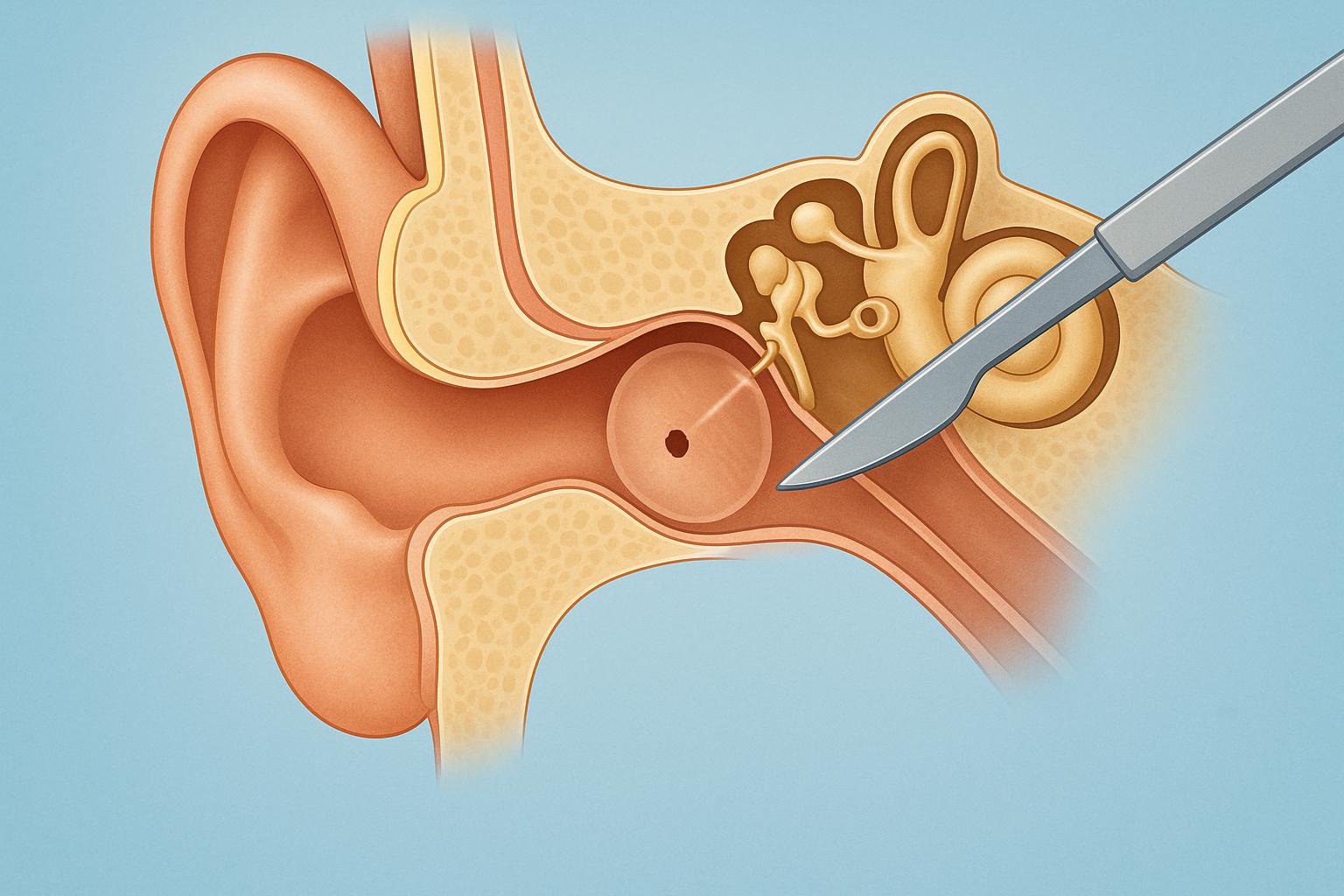
Ear problems are often treated with medication, observation or hearing devices. However, when structural damage, recurrent infections or significant hearing loss persists, ear surgery may become an important part of treatment.
Two situations commonly raise questions for patients and families: whether a perforated eardrum needs to be repaired and whether a person with significant hearing loss could benefit from a cochlear implant. These decisions are not based on symptoms alone. An ENT specialist will usually consider the condition of the ear, hearing test results, the frequency of infections and how much the problem affects everyday communication.
For patients in Singapore, understanding when surgery may be appropriate can make it easier to recognise when persistent ear problems require specialist assessment.
When does a perforated eardrum need treatment?
The eardrum, or tympanic membrane, is a thin structure that separates the ear canal from the middle ear. It vibrates when sound enters the ear and plays an important role in hearing.
A hole or tear in the eardrum is known as an eardrum perforation. It can develop after an ear infection, trauma, sudden pressure changes or an injury caused by inserting an object into the ear.
Not every perforation requires immediate surgery. In many cases, the eardrum can heal naturally, particularly when the underlying infection has been treated and the ear is protected from further irritation. Observation may therefore be appropriate when the perforation is relatively recent, there are no ongoing infections and hearing is not significantly affected.
However, a perforation that does not heal can become a longer-term problem.
According to SingHealth, surgical repair may be considered when an eardrum perforation persists for more than three months or when there are recurrent ear infections with discharge.
Myringoplasty or observation?
The decision between myringoplasty and observation depends on several factors.
Observation may be suitable when:
– The perforation is expected to heal naturally.
– There is no persistent or recurrent ear discharge.
– There is no significant hearing impairment.
– The ear is otherwise healthy.
– There are no signs suggesting more serious middle-ear disease.
Small eardrum perforations may heal naturally with observation, while keeping the ear dry and attending follow-up appointments. Myringoplasty may be recommended for persistent perforations to repair the eardrum, reduce recurrent infections and potentially improve hearing. If the middle-ear bones are also damaged, tympanoplasty may be needed to repair the eardrum and reconstruct hearing structures.
Why recurrent ear infections should not be ignored
Occasional ear infections are common, but repeated infections accompanied by persistent discharge or hearing difficulties deserve further assessment.
A chronically perforated eardrum can provide a pathway for bacteria to enter the middle ear, particularly when water enters the ear. Repeated inflammation can then contribute to ongoing discharge and damage within the middle ear.
Recurrent ear infections can also affect hearing over time. Hearing loss may result from the perforation itself or from damage to the tiny bones of the middle ear, known as the ossicles.
This is particularly important in children because hearing plays a central role in speech, language and learning. In adults, persistent hearing difficulties can interfere with conversations, work and social interactions.
A hearing test, or audiogram, is therefore often an important part of assessing someone with recurrent infections or a persistent eardrum perforation.
Patients should seek an ENT assessment if they experience symptoms such as:
– Repeated or persistent ear discharge
– Hearing loss that does not resolve
– Recurrent ear pain or infections
– Ringing or other noises in the ear
– Dizziness associated with ear symptoms
– A known perforation that has failed to heal
An ENT examination is also important because persistent middle-ear disease can occasionally be associated with a cholesteatoma, an abnormal collection of skin in the middle ear. Although uncommon, cholesteatoma can progressively damage the structures of the ear and lead to complications if left untreated.
How long-term ear disease can affect hearing
Hearing loss can occur when any part of the hearing pathway, from the eardrum and middle-ear bones to the inner ear and hearing nerve, is affected. Eardrum perforations and chronic ear infections commonly cause conductive hearing loss, which may improve with appropriate ear surgery. However, when the cochlea or hearing nerve is affected, different treatment options may be required.
When are cochlear implants considered?
A cochlear implant differs from a hearing aid by bypassing damaged inner-ear hair cells and directly stimulating the auditory nerve. It may be recommended for people with severe to profound sensorineural hearing loss who gain limited benefit from hearing aids. Suitability depends on factors such as speech understanding, hearing-aid benefit and the condition of the auditory nerve, with selected patients with single-sided or asymmetric hearing loss also potentially eligible.
How does a cochlear implant work?
A cochlear implant has an external component and an internal component.
The external processor includes a microphone that picks up sounds from the environment. It processes these sounds and sends the information to the internal receiver-stimulator through a connection across the skin.
The internal component then converts the information into electrical signals. An electrode array positioned inside the cochlea stimulates the auditory nerve, allowing sound information to reach the brain without relying on the damaged hair cells that normally perform this function.
The process can be summarised as:
Sound >> microphone >> speech processor >> internal implant >> cochlear electrodes >> auditory nerve >> brain
A cochlear implant does not restore normal natural hearing. Instead, it provides a different way for the brain to receive sound information. The sound experience can initially feel unfamiliar, and patients usually require a period of adjustment and auditory rehabilitation.
Following surgery, the implant is activated and programmed by an audiologist. Ongoing mapping and rehabilitation can help patients make better use of the device.
Who may benefit from a cochlear implant?
Cochlear implantation may be considered when hearing aids no longer provide sufficient functional benefit.
Assessment may be appropriate for someone who:
– Has severe to profound hearing loss.
– Has limited speech understanding despite appropriately fitted hearing aids.
– Continues to struggle with communication even when using hearing technology.
– Has hearing loss affecting both ears, or selected cases of single-sided deafness or asymmetric hearing loss.
– Is medically suitable for implantation and rehabilitation.
Importantly, cochlear implants are not only for children. Adults, including older adults, may benefit when hearing loss significantly limits communication and hearing aids are no longer sufficient. SingHealth notes that the range of indications for cochlear implantation has expanded as technology and clinical experience have developed.
Children with significant hearing impairment may also be assessed for implantation because access to sound is particularly important during critical periods of speech and language development.
What happens before ear surgery?
Before ear surgery, an experienced ENT specialist assesses the ear and hearing to determine whether surgery is necessary and which approach is most appropriate. This may involve an ear examination, hearing tests and, when needed, imaging. For cochlear implant candidates, additional speech and imaging assessments may be performed. The aim is to identify the cause of the hearing problem and choose treatment that can improve hearing, prevent recurrent infections and support long-term quality of life.
When should you see an ENT specialist?
A single episode of an ear infection does not necessarily mean surgery is needed. However, persistent ear discharge, recurrent infections, an eardrum perforation that does not heal or progressive hearing loss should not be ignored.
For some patients, observation and medical treatment may be all that is required. For others, repairing the eardrum can help prevent recurrent infection and improve hearing. When hearing loss originates in the inner ear and hearing aids are no longer sufficient, a cochlear implant may provide another route to better hearing and communication.
The right treatment depends on the cause, severity and duration of the ear problem. An ENT specialist can assess the condition of the ear and hearing, explain whether observation or surgery is appropriate, and recommend the most suitable option for long-term hearing health.