


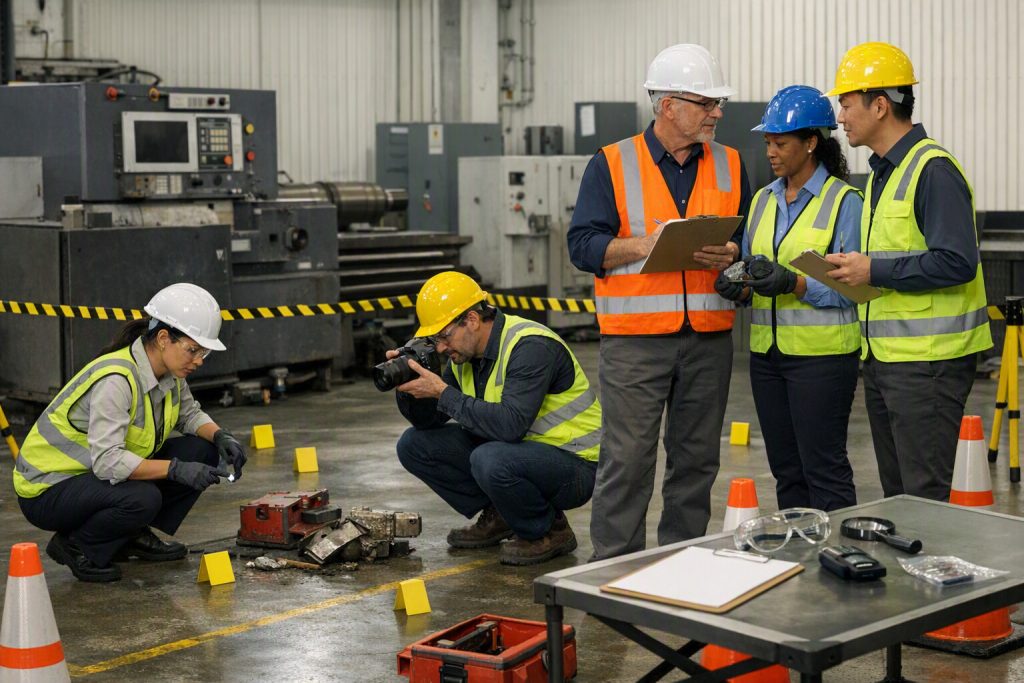
When a serious workplace incident occurs, finding out what happened is often the easy part. The harder questions are why it happened, what conditions contributed to it and what needs to change to reduce the risk of it from happening again.
That is where the quality of an incident investigation matters. A rushed investigation can settle on the most visible explanation, while an effective investigator looks beyond individual actions to understand the wider circumstances surrounding an event. Guidance from the UK’s Health and Safety Executive (HSE), for example, emphasises looking beyond immediate causes to identify underlying and root causes.
Leading that process requires more than technical safety knowledge. You need analytical ability, communication skills, objectivity and enough leadership capability to keep an investigation focused when information is incomplete or competing views emerge.
In this article, you will learn seven practical skills that can help you lead workplace incident investigations that produce clearer findings and more useful safety improvements.
Table of contents
- Structured investigation planning
- Evidence collection and preservation
- Effective interviewing
- Analytical and critical thinking
- Objectivity and impartiality
- Communication and investigation leadership
- Turning findings into effective corrective actions
1. Structured investigation planning
Good investigations start before the first interview takes place. Investigators need to establish what they are examining, who needs to be involved and how evidence will be gathered.
A useful investigation plan should consider:
- The scope and objectives of the investigation
- Immediate evidence that could be lost or altered
- Relevant witnesses and subject-matter experts
- Documents, procedures and records that need reviewing
- Roles and responsibilities within the investigation team
- Reporting requirements and realistic timeframes
Think of an investigation like assembling a jigsaw puzzle. If you start forcing pieces together before seeing what is available, you may create a convincing picture that is nevertheless wrong.
For people expected to manage more complex investigations, completing a structured investigator course can help develop practical skills around planning investigations, collecting and analysing evidence, identifying systemic contributing factors and leading investigation teams.
2. Evidence collection and preservation
An investigator’s conclusions are only as reliable as the evidence supporting them. Evidence can include much more than photographs of an incident scene.
Depending on the event, useful sources may include:
| Evidence type | Examples |
| Physical | Equipment, damaged components, PPE and environmental conditions |
| Documentary | Procedures, permits, maintenance records and risk assessments |
| Digital | CCTV footage, system logs, emails and equipment data |
| Human | Witness accounts, supervisor interviews and technical expertise |
| Organisational | Training records, rosters, audits and previous incident reports |
Investigators need to distinguish between facts, assumptions and interpretations. Two people may look at the same piece of evidence and reach different initial conclusions, which is why information should be documented carefully before theories become fixed.
Where teams are geographically dispersed or need flexible access to capability development, options such as ICAM training online can also support the development of a consistent, structured approach to investigation across an organisation.
3. Effective interviewing
Interviewing is one of the most important — and easily mishandled — parts of workplace incident investigation.
A witness interview should help someone recall and explain what they experienced. It should not feel like an interrogation designed to prove a theory.
Effective investigators generally:
- Ask open-ended questions before narrowing down details
- Use neutral language
- Listen without unnecessary interruption
- Separate firsthand observations from assumptions
- Clarify inconsistencies without becoming confrontational
- Avoid questions that suggest the expected answer
For example, asking, “What did you notice immediately before the equipment stopped?” is more useful than asking, “You saw the warning light, didn’t you?”
The first question invites information. The second risks shaping it.
The HSE’s investigation guidance also highlights the importance of gathering information and speaking with people who were involved so that investigators can build an accurate understanding of what happened.
4. Analytical and critical thinking
Incidents rarely result from one isolated failure. A worker may make an error, but simply identifying that error does little to explain why it occurred.
Strong investigators keep asking questions.
Was the procedure practical? Was the person trained? Was equipment suitable for the task? Were production pressures influencing decisions? Had similar problems previously been reported? Did supervision, communication or workplace design contribute?
This is where analytical thinking becomes essential. Rather than looking for a single person or action to blame, the investigator considers how different factors interacted.
| Surface-level question | Deeper investigation question |
| Who made the mistake? | What conditions made the error possible or more likely? |
| Which procedure was breached? | Was the procedure understood, practical and routinely followed? |
| Why didn’t the worker notice the hazard? | What controls were supposed to prevent exposure to the hazard? |
| What failed? | Why was that failure able to produce the incident? |
This approach produces findings that organisations can actually learn from.
5. Objectivity and impartiality
One of the biggest risks in an investigation is deciding what happened too early.
Once investigators develop a preferred explanation, confirmation bias can lead them to notice evidence supporting that theory while unconsciously giving less weight to contradictory information.
Objectivity means being willing to change your conclusion when the evidence changes.
Practical ways to protect impartiality include:
- Testing alternative explanations
- Clearly separating evidence from interpretation
- Asking another team member to challenge assumptions
- Recording contradictory evidence rather than dismissing it
- Avoiding blame-focused language
- Declaring potential conflicts of interest
An effective investigation is not about proving the first theory right. It is about finding the explanation that best fits the available evidence.
6. Communication and investigation leadership
Lead investigators rarely work alone. They may need input from operational staff, engineers, health and safety professionals, managers, contractors and employee representatives.
That means leadership matters.
A good lead investigator keeps people focused on the purpose of the investigation while creating enough psychological space for team members to challenge assumptions and contribute different perspectives.
Communication is equally important when presenting findings. Senior leaders may not need every technical detail, but they do need to understand:
- What happened
- What evidence supports the findings
- Which factors contributed to the event
- Where existing controls were ineffective
- What actions should be considered next
Clear communication turns a complex investigation into information that decision-makers can use.
7. Turning findings into effective corrective actions
An investigation is not successful simply because the final report is comprehensive. Its real value comes from what the organisation does with the findings.
Weak corrective actions often focus heavily on reminders, retraining or telling workers to “take more care”. Those actions may have a place, but they do not necessarily address deeper weaknesses in equipment, processes, supervision or organisational systems.
Investigators should therefore ask whether proposed actions:
- Address identified contributing factors
- Reduce exposure to the underlying risk
- Have a clear owner and timeframe
- Are practical in normal working conditions
- Can be measured or verified
- Introduce any unintended risks
The aim should be organisational learning rather than simply closing an investigation file. This aligns with structured investigation approaches that focus reducing risk[a]recurrence and reducing risk rather than stopping at surface-level explanations.
Better investigations create better opportunities to learn
Workplace incident investigations sit at an important point between an event that has already happened and the decisions that determine what happens next.
The most effective investigators do more than collect statements and complete reports. They plan methodically, protect the quality of evidence, interview people fairly, question assumptions and look beyond immediate actions to understand the wider system.
Developing these seven skills helps shift an investigation away from “Who caused this?” and towards the more useful question: “What can this incident teach you about how work is really being done?”
When that question guides the investigation, the result is more likely to be meaningful learning, stronger controls and practical action that reduces the chance of recurrence.